


By Dr. Jason Valley of Heritage Classical Academy
“There is a lot more in him than you guess, and a deal more than he has any idea of himself.” I will never forget the first time my eyes landed upon the words of Gandalf from The Hobbit. Gandalf’s proclamation here reveals his determination to magnify the potential of Bilbo Baggins in the eyes of both the dwarves and Mr. Baggins himself. Gandalf perceived something in Bilbo, and in that moment, Bilbo and the dwarves were not capable of apprehending that truth spoken by Gandalf. To his newly found peers, Bilbo was a gluttonous, comfortable, pleasure-seeking little hobbit. But Gandalf did not see that. Gandalf saw Bilbo—the irreducible Bilbo.
The profundity of Gandalf’s prophetic announcement brought me to a screeching halt as visions of each of my students flashed onto the eyes of my soul. I then asked myself a critical question: Do I see each of my students as Gandalf sees Bilbo—as being so much more than a seemingly insignificant little hobbit? I set the book down, and I contemplated.
It was not long into my contemplation that truth roared with its characteristically gentle voice: “The lens through which you perceive your students will determine how you educate them.” Truth had spoken, and I was left to wrestle with the implications of its message. Let us first examine the latter part of this message to establish the means and ends of classical Christian education in order to ascertain our telos as classical Christian educators. An elucidation of the purpose of classical Christian education and the role we as educators play therein should then allow us to evaluate the corresponding acuity of the lens through which we perceive our students. A familiar Biblical story of two sisters situated in the same room but differing in posture will help us on this quest.
Classical Christian educators, as delineated by the CIRCE Institute, should strive to cultivate virtue and wisdom in their students by nourishing their souls on the true, good, and beautiful so that, in Christ, the student is enabled to better know, glorify, and enjoy God. Fundamentally, the conclusion of it all is communion with the Savior, sitting at His feet. When one considers this idea of sitting at His feet, one cannot help but think of Mary, who sat at the Master’s feet and “chose the good portion, which will not be taken away from her” (Luke 10:42). The optimal Biblical comparison to the telos of classical Christian education is arguably found in the posture of Mary, communing with the Master while seated at His feet. At the Master’s feet is where our students find the good portion, where their souls are nourished on truth, goodness, and beauty. Thus, if communion with Christ while seated at His feet is the good portion, might there exist a less-than-good portion? Enter Martha.
Martha is distracted, anxious, and troubled about many things. Martha might be worried about performing well on her next test, or she might be concerned about her final grades on her report card, or she is daily doing her best to exhibit good behaviors in class. Discernibly, Martha’s position here is utterly discordant with the essence of a classical Christian education.
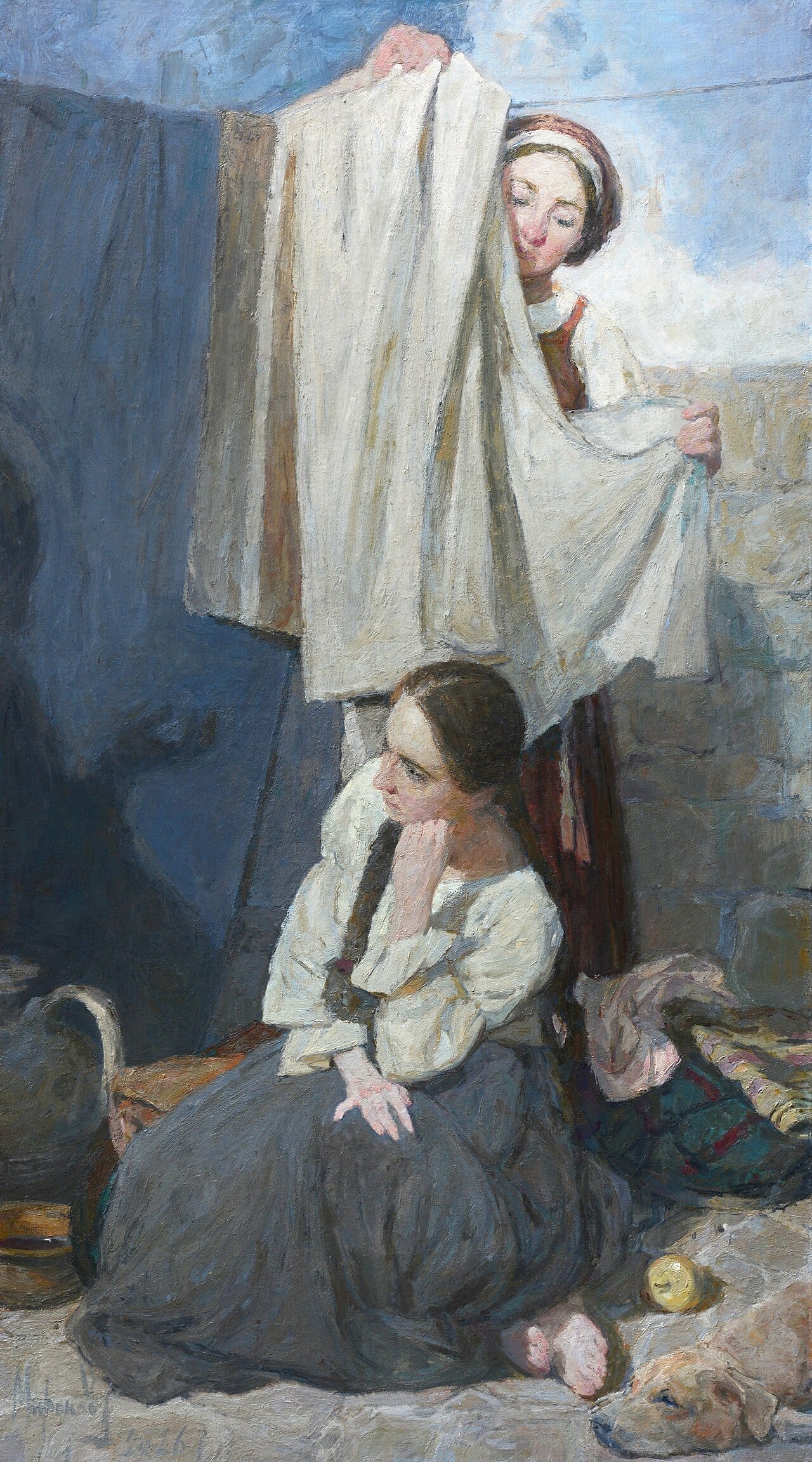
Consider the differences between our two students. Mary is free; she is free to know, glorify, and enjoy truth, goodness, and beauty Himself. By choosing the good portion, Mary’s soul is being cultivated with wisdom and virtue as she listens to her Master speak to her. On the other hand, Martha, at this moment, is a slave; she is a slave to busyness and production, thereby distracting her from a clear perception of that which is true, good, and beautiful. The distinction here between Mary and Martha is evident, and analogically speaking, Mary exemplifies our ideal educational outcome.
Thus, let us now revisit the assertion above: The lens through which we perceive our students will determine how we educate them. If indeed we desire to lead our students to the feet of the Master, we must perceive them accurately. Gandalf, in all his wisdom, has spoken the words that can lead us to an accurate perception of our students. Imagine, for a moment, walking about your classroom and invoking the words of Gandalf on each of your students. I contend that the advancement of such a proclamation reinforces an eternal truth: each student is more than the sum of his or her parts. In fact, each student is a masterpiece fashioned by the hands of the Master who has stamped His image upon them. “For we are His workmanship [masterpiece] created in Christ Jesus for good works, which God prepared beforehand so that we would walk in them” (Ephesians 2:10). A masterpiece is a sublime work of art skillfully created by a master. Christ is their Master, and the “deal more” is His image. In The Problem of Pain, Lewis states, “We are not metaphorically but in very truth, a Divine work of art, something that God is making, and therefore something with which He will not be satisfied until it has a certain character.”
The Master is intimately invested in His work, and He is calling his masterpieces to Himself (Mark 10:14; Matthew 11:28-29; John 7:37; John 6:51). We have learned from Mary that the good portion is heeding that call and resting at His feet. Recall CIRCE’s definition of classical Christian education; when the masterpiece communes with the Master, the means and ends of classical Christian education are accomplished. Thus, the classical Christian educator has the eternal responsibility of recognizing that the “deal more” in each student is the Master’s handiwork that ultimately belongs in His presence in order to be continuously fashioned.
Despondently, there is always a serpent around, and temptation can blur the vision. Even as classical Christian educators, we can be tempted to perceive our students as their intellectual capacities, behaviors, grades, and so forth. Such a reductionistic perspective of our students engenders a pragmatic educational approach, which will either address the students’ shortcomings or accelerate their strengths, both of which, when done in isolation, are innately iniquitous. Moreover, we can be tempted to perceive our students as something like computers into which (notice how I did not say whom) we are working our hardest to download an abundance of information. The student is essentially reduced to a test taking machine. This reductionistic lens will induce an education that is demonstrably divergent from the telos of classical Christian education. Any attempt to transmit truth, goodness, and beauty in the classroom will only become an intellectual exercise, bypassing the transformative power of the transcendentals, and at best, producing brilliant Marthas whose primary affections are for achievement, high grades, and excellent behaviors. The inability to consistently satisfy such affections will leave the student distracted, anxious, and troubled.
“Stamp eternity on my eyeballs!” exclaimed the great preacher, Jonathan Edwards, as he would pray. I believe that this is the decree to us educators! “We must fix our eyes not on what is seen, but on what is unseen. For what is seen is temporary, but what is unseen is eternal” (2 Cor. 4:18). Academic production and classroom behaviors are seen. The unseen, or the essence of the masterpiece, appears through an eternal lens. When we perceive our students as masterpieces made by the Master who longs for them to sit as His feet, we are more apt to properly position our students to be like Mary, sitting at the Master’s feet and delighting in the good portion which shall not be taken away from them.
Thus far, I have argued that the telos of education is communion with Christ, sitting at His feet. One might ask, “In an educational setting, what does sitting at the Master’s feet look like?” At the Master’s feet, the student begins to learn that just as they are essentially irreducible, so is every subject of study in the classroom, whether it is grammar, math, literature, etc. Certainly, each subject of study must be analyzed, but the ultimate perception of these subjects should be an eternal one because each of them is eternally founded in the Logos, Christ Himself. Because of this eternal founding in Christ, these subjects are interwoven to form a beautiful tapestry and should be discussed as such with our students. At His feet, they hear Him exclaim, “This is all Mine!” So the goal becomes training our students to gaze upon that which is eternal in every subject, so that through it all, they see their Master Himself, Christ, and are thus transformed.
There is indeed so much more to this “Bilbo” who sits at his desk each day, a deal more than he has any idea of himself. The “deal more” in our students signifies that they are eternally more than their intellectual capacities, behaviors, grades, etc. As masterpieces made in His image, they are of infinite worth and meant for glory. If it is indeed true that the lens through which we see our students determines how we educate them, let us cast aside a reductionistic vision, which yields a propensity to produce anxious and troubled Marthas. Conversely, let us stamp eternity onto our eyeballs and perceive the “deal more” in our students. This perception will facilitate an education that leads the masterpiece to the feet of the Master where wisdom and virtue are cultivated, where truth, goodness, and beauty are feasted upon, and where the Master becomes known, glorified, and enjoyed—the good portion, which will not be taken from him.